 Top Trending
Two Bottles and a Pouch of Lion's Mane: A Gram a Day, Nine Months
Two bottles of capsules and a pouch of powder, one extract, from Real Mushrooms. I weighed a gram a day against a trial that used three times as much, and checked how long the box really lasts.

This is a paid advertisement. Sponsored by Real Mushrooms Inc.

Dale Whitcomb is the pen name of this desk.
The customers quoted on this page are real; their reviews are public on the seller's page for the capsules included in this bundle, not for the bundle itself, and were read there on September 9, 2026.
I haven't met them and know nothing about them beyond what they wrote.
The small photos beside their reviews are illustrations, not the reviewers.
Everything about the box, from the two panels to the discount arithmetic, comes from the seller's own labels and pages, read the same day.
There's a kind of man who buys the big box because he's decided, and a kind who buys the big box because the page told him it was cheaper.
This page is for the first kind, and it's a caution for the second.
The box holds two bottles of capsules and a pouch of powder, all the same lion's mane extract, and if you take one gram a day it lasts the better part of a year.
What it doesn't hold, despite the name, is the seller's product called FOCUS.
And the "compare at" price on the page is fifteen dollars higher than the parts add up to.
Both of those are on the seller's own site, and I'll show you where.
That isn't a verdict either way.
It's the kind of thing you want to know before nine months of anything.
One gram of extract a day, as two capsules or as half a teaspoon in a cup. Every number on this page is for that gram, and for the box that holds about 270 of them.
Here's what the box is.
The Lion's Mane Focus Bundle, from Real Mushrooms, a company with its office in Calgary, Alberta, that grows its mushrooms organically and ships American orders from Sparks, Nevada.
Inside: two bottles of 120 capsules of organic lion's mane extract, and one 150-gram pouch of the same extract as a loose powder.
The capsule panel: 1,000 milligrams of extract per two capsules, of which 300 milligrams are beta-glucans, in a vegetable capsule with cellulose and silicon dioxide.
The powder panel: 1,000 milligrams of extract per gram, of which 300 milligrams are beta-glucans, and nothing else in the pouch.
That's it.
One mushroom, two forms, no other line.
I did what I always do.
I read the two labels before the listing.
I read the trial behind the mushroom, at the dose it actually used, in people as old as I am.
I did the arithmetic on the box, twice, because the seller's page and its own component pages don't agree on the discount.
And I read the reviews of the capsules, because the bundle's own review widget is empty.
What I found is the same honest extract I'd buy on its own, sold in a quantity that only makes sense if you've already decided, under a name that promises a product it doesn't contain, at a discount smaller than the page says.
The Name You Knew Five Seconds Ago
Let's start somewhere ordinary, because that's where this starts for most of us.
You're on the porch with a friend, and you're telling him about a man you both used to know.
You can see his face. You can see his truck.
And his name is gone.
Not gone for good, just gone for now, sitting somewhere behind your teeth.

Your friend waits. You wave your hand like you're clearing smoke.
Ten minutes later, while he's talking about something else, the name walks back in on its own.
Sound familiar?
I thought so.
It isn't only names, either.
You read a paragraph in the paper, get to the bottom, and realize you'll have to read it again.
You walk into the kitchen with a purpose.
Then you stand there, one hand on the back of a chair, waiting for the purpose to catch up.

None of this is a big deal, and I'm not going to pretend it is.
It's the small stuff, the stuff you laugh about with your wife and your friends.
But you notice it.
And somewhere around sixty, a lot of men start wondering whether there's anything sensible to do about it, beyond laughing.
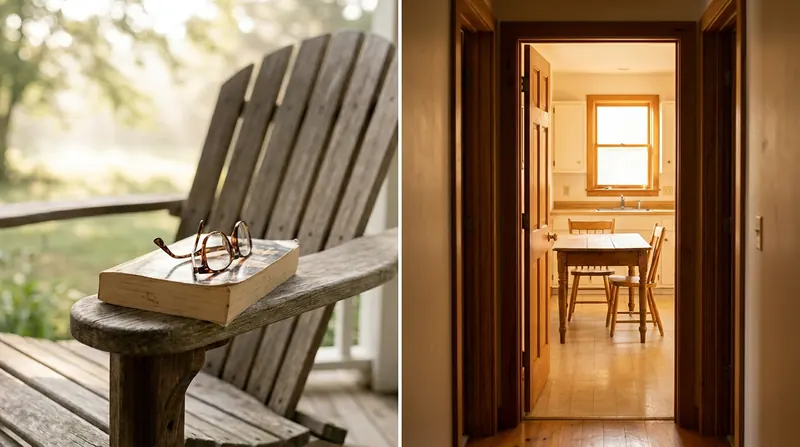
That's the question this page is really about.
Not a crisis. A habit, and whether a gram of mushroom a day belongs in it.
If you're here because of names and paragraphs and doorways, you're in the right place. If you're here because something bigger worries you, this page isn't where that gets answered, and I'll say more about that near the end.
There are a dozen more of these, and you know every one.
The actor in the old movie whose name you know as well as your own brother's.
The phone number you've dialed for thirty years, suddenly short a digit.
The row at the hardware store parking lot you were sure you parked in.
Is that just getting older?
I'm not the one to tell you what it is, and neither is any page that sells something.
What I can tell you is that you're in large company.
I've never met a man past sixty who didn't have a doorway story, and most of them have two.
We joke about it at the diner, and that's healthy.
The joke is usually the same one: "I came in here for something."
The Usual Workarounds, and Why They Only Cover the Moment
So what do we do about the name on the porch?
Mostly, we work around it.
- A list on the fridge, and a second list in the shirt pocket.
- Keys on the same hook, every time, so you never have to remember where.
- A second cup of coffee when the afternoon feels slow.
- "You know who I mean," and a friend who usually does.
Nothing wrong with any of that.
I do every one of those things, and so does every man I know.
But notice what they have in common.
They're all for the moment you're in, and none of them asks anything of the next nine months.
The list gets you through the grocery store.
It doesn't change the man holding the list.
Some men add the crossword, or the jigsaw on the card table, or a phone game the grandkids set up.
I like the crossword, and I'd never tell you to stop.
But is a puzzle a plan?
It's a pleasure, which is reason enough, and it's not something I can put a number on for you.
And then there's the oldest workaround of all: try harder.
Squint at the name, grit your teeth, go through the alphabet.
You know how that goes: the name turns up the minute you stop chasing it.
Then there are the plain basics, the ones that actually have some study behind them.
You've heard them, and I'd be doing you a disservice if I skipped them.
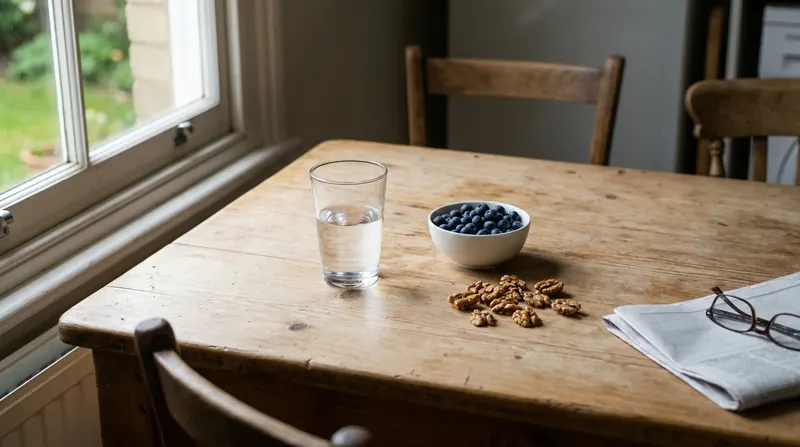
Is a glass of water really on the list?
It is, and it's the cheapest thing on this page.
In a Berlin study of 1,111 adults aged 60 to 89, the third who were measurably short on water fell further over time on a speed-of-thinking test than the rest. [1]
That's an association, not proof, but a glass of water costs you nothing to try.
What about the food on the plate?
The eating pattern most studied for memory is the one built on vegetables, berries, beans, nuts, whole grains, fish and olive oil.
In a three-year trial of 604 older adults, the group eating that way and a group simply eating a little less both improved their thinking scores, by about the same amount. [2]
So the plate matters, and the honest lesson is that the everyday habit around it matters too.
Walk most days. Keep regular hours for rest, and keep seeing your friends.
Get your hearing checked if the television keeps creeping louder, because straining to hear looks a lot like not remembering.
Those are the foundation. Nothing in any box replaces them, and nothing on this page asks you to swap them for anything.
So why is there a box on this page at all?
Because some men do all of that and still want one more small, steady thing in the morning, measured and honest, that they can keep up for months.
That's where the mushroom comes in.
One Mushroom That Grows on Old Oak and Beech
Lion's mane is an edible mushroom with long white spines that grows on old beech and oak trees.
It's eaten as food in East Asia and, more and more, here at home.

If you've ever seen one at a farmers' market, it looks like a small white beard.
Cooked in a skillet, people compare the texture to crab.

What part of the mushroom goes into the box?
The fruiting body, which is the part you see on the tree, the white beard itself.
That matters more than it sounds.
Some mushroom products are grown on grain, and the seller's point is that its extract has no grain or filler in it.
How is it made?
The labels say hot-water extracted, which is roughly what you'd do with a pot in your own kitchen, done at scale and dried to a powder.
Is it organic?
Both labels say organic, and the pouch carries the USDA organic seal.
So why would anyone put it in a capsule?
Because one small trial in people our age made it famous, and the trial is worth reading slowly.
What did that trial actually do?
Thirty-one Japanese adults over 50 took a daily preparation of the dried fruiting body, 3.2 grams a day, or a placebo, for twelve weeks.
The lion's mane group scored higher on a standard mental-status test than the placebo group. [3]
The difference faded in the weeks after they stopped.
Did everything they measured go up?
No, and that's worth knowing.
A test of visual memory in the same trial didn't change.
One score moved, one didn't, in thirty-one people, over twelve weeks.
Is there anything newer?
There's a second study, in younger people, and it's honest to mention.
Forty-one healthy adults aged 18 to 45 took a single 1.8-gram dose or a placebo, and the lion's mane group was faster on an attention task an hour later. [4]
After 28 days at that dose, there was a trend on one questionnaire and nothing clear on the other tests.
Who were the people in that trial?
Healthy Japanese adults over 50, in the study's own description, not people picked because anything was wrong.
That's closer to you and me than most supplement studies get.
It's also only thirty-one people, and one trial is a starting point, not a verdict.
Small studies, real results, modest ones.
That's the whole shelf of human evidence I'd stand behind for this mushroom.
It's thin, and I'd rather you heard that from me than found it out on your own.
One Gram a Day, and the Trial That Used Three Point Two
Here's the line the whole box stands on.
Every number on this page is for one gram a day, so let's be clear about what a gram is.
Three point two grams a day, for twelve weeks.
That's the trial.
This box gives you one gram a day, of an extract the seller's own Canadian label calls one-to-one.
So roughly one gram of dried mushroom.
A third of the trial's daily amount.
If you took the capsules and the powder on the same day, that's two grams, closer to the trial, and the box lasts half as long.
And against the younger group's single dose?
A gram is a little over half of that 1.8 grams.
A gram a day is a real amount of the right part of the mushroom, honestly labeled. It's also a third of the only twelve-week dose ever tested in people over 50.
I'm not telling you that to talk you out of it.
I'm telling you so you know what you're buying before you buy it.
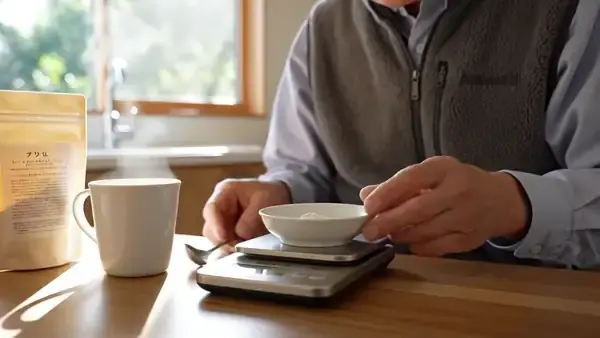
Three Hundred Milligrams Printed on Both Panels
Now the number most mushroom labels leave off.
It's the reason I trust these two labels more than most.
What are beta-glucans?
They're long chains of glucose that make up much of the cell wall of a mushroom.
A serious mushroom-extract maker measures them to show how much mushroom, rather than grain or filler, is in the product.
A hot-water extract concentrates them.
What does this box print?
Both panels print 300 milligrams per gram, which is 30 percent, and the seller's page says it promises more than that.
Does that number do anything for memory?
Not that anyone has shown. I found no trial of beta-glucans on memory or attention in healthy adults.
Think of it like the octane rating on a gas pump.
It tells you what's in the fuel, not how far you'll drive.
Thirty percent beta-glucans, printed, is the honest reason to prefer this extract over a cheaper one.
It isn't a reason to expect anything the 3.2-gram trial didn't find.
What's Actually in the Box
So that's the mushroom.
Now let's open the box.
The bottles are white with cream labels, each about the height of a coffee mug.
The pouch is a stand-up bag with a zip seal, about the size of a paperback.
I turned each one around and read the backs.
Here's what I asked them, and what they said.
What's in two capsules?
Organic lion's mane mushroom extract, 1,000 milligrams, of which 300 milligrams are beta-glucans.
What else is in the capsule?
Hypromellose, which is the capsule itself, plus microcrystalline cellulose and silicon dioxide.
And the powder?
Per gram, about half a teaspoon: 1,000 milligrams of the same extract, 300 milligrams of beta-glucans, and no other ingredient at all.
How much am I supposed to take?
Adults take two capsules a day, or one gram of powder once a day.
Is it a concentrate?
No. The seller's Canadian label calls the extract "1:1," so a gram of this extract is about a gram of dried mushroom.
One mushroom, hot-water extracted from the fruiting body, with the beta-glucan figure printed on both.

A Bundle Called Focus That Doesn't Contain the Product Called FOCUS
This is the part I'd want a friend to tell me before I ordered.
So I'm telling you.
Real Mushrooms sells a separate product called Lion's Mane FOCUS.
It's a capsule with 500 milligrams of lion's mane, 100 milligrams of cordyceps and 200 milligrams of a choline compound.
The box on this page is called the Lion's Mane Focus Bundle.
It does not contain that product.
The seller's own listing says what's inside: "Organic Lion's Mane Extract Capsules, 120 count ×2; Lion's Mane Mushroom Powder, 150 g ×1."
Plain lion's mane, in two forms. No cordyceps, no choline compound.
I don't think anyone meant it badly.
It's probably a name chosen by a marketing team that already had a product called FOCUS and wanted the word on more boxes.
But you're buying nine months of something.
You should know which something.
The bundle is plain lion's mane extract, a gram a day, twice over. If you wanted the three-ingredient FOCUS capsule, this isn't it.
Capsule or Spoon: Which Form to Start With
Two forms of the same gram sounds simple.
But it raises a fair question: which one do you open first?
Start with the capsules if you want the plainest test.
Two a day, same breakfast, nothing to measure and nothing to taste.
There's a money reason too.
The return page only takes back unopened items, so a sealed pouch is a pouch you can still send back.
Start with the powder if you like a ritual.
Some men like the kettle, the spoon and the mug more than they like swallowing capsules, and a habit you like is a habit you keep.
Half a teaspoon is about a gram, per the label.
A level measuring spoon is more honest than a heaping kitchen spoon.
Can you switch back and forth?
Yes, and that's what the box is for: capsules on the road, powder at home, one gram either way.
One gram, whichever door it comes through.
Five Questions I Put to the Seller's Page
A label tells you what's in the bottle.
The seller's page tells you how the company wants you to think about it, and that deserves a closer read.
What does the seller say the bundle is for?
In its own words, it's there to help you "stay consistent and build a habit that supports your daily focus and clarity."
That's the seller's sentence, not a finding, and both labels carry the standard line that the FDA hasn't evaluated their claims.
The honest part of that sentence is the word habit.
Does the seller print where it is?
Yes: a street address in Calgary, a toll-free number and an email, on the labels and on the site.
Does it say how it checks the extract?
Both labels say the extract is verified for its active compounds, and both print the beta-glucan figure that goes with that.
Does it sell the parts on their own?
Yes, on the same site, which is how I could check the discount arithmetic for you further down this page.
Is there anything it doesn't say?
It doesn't point out that the bundle leaves out the FOCUS capsule; you have to read the list of contents to see it.
A seller that prints its address, its number and its beta-glucans is a seller worth reading closely. Reading closely is also how you find the name problem.
So here it is, all three items in one picture, with what I'd want printed beside it.
What Has Been Studied, Said Plainly
Every supplement page has a section called "benefits."
This is mine, and I'm going to keep it to what's actually been measured.
- Adults over 50 who took 3.2 grams a day of the dried mushroom for twelve weeks scored higher on a standard mental-status test than a placebo group. [3]
- That difference faded after they stopped, which tells you it's a daily habit or nothing.
- A visual-memory test in the same trial didn't change.
- Younger adults were faster on an attention task an hour after a single 1.8-gram dose. [4]
- After 28 days at that dose, the other tests showed nothing clear.
So what can a gram a day honestly give me?
A measured, labeled amount of a well-made extract, in a form you'll actually keep taking.
That's not nothing.
Consistency is the one thing the trial shows mattered: the difference was there while people took it and faded when they stopped.
And what can't it give me?
A promise. Nobody has tested this box, at this amount, in anyone.
If a page tells you a gram of mushroom will sharpen your memory, close that page. This one won't tell you that.
An Ordinary Tuesday With a Gram in It
Numbers are one thing.
Let me show you what the habit actually looks like on a normal day.
Seven in the morning.
The kettle goes on, same as always.
If you're home, half a teaspoon of powder goes in the mug before the water.
Stir, and it clouds a little and settles.

Eight, if you're heading out.
Two capsules with breakfast instead, and the pouch stays in the cupboard.
That's the whole point of two forms.
The capsules are for the days you're on the road; the powder is for the days you're home with a mug.
Mid-morning.
The walk, the errands, the hardware store, the friend who wants to talk about his tomatoes.

None of that changes because of a capsule.
It shouldn't, because those are the basics we talked about, and they matter more.
Afternoon.
Maybe a second cup of coffee, maybe not; there's no caffeine in the box to count.
Evening.
One line in a notebook, before the television goes on.
Not "sharper" or "foggier."
Something you can check later: what you were doing at ten, and how it went.

And maybe a word with your wife about how the week went.
She'll notice things you won't, and she won't be shy about it.

And on the weekend?
Same thing, and that's the whole idea of a habit: it doesn't take Saturdays off.
What about a trip?
Count the capsules for the days you'll be gone into a small travel container, and leave the pouch at home.
And if you forget a morning?
Take it the next morning as usual; the label says once a day, and nothing on it says to double up.
That's it. A spoon or two capsules in the morning, one line at night, and everything else exactly as it was.
Nine Months of a Gram, and a Discount Smaller Than the Page Says
Now the arithmetic.
This is the part that decides whether the box is for you or for someone who's already sure.
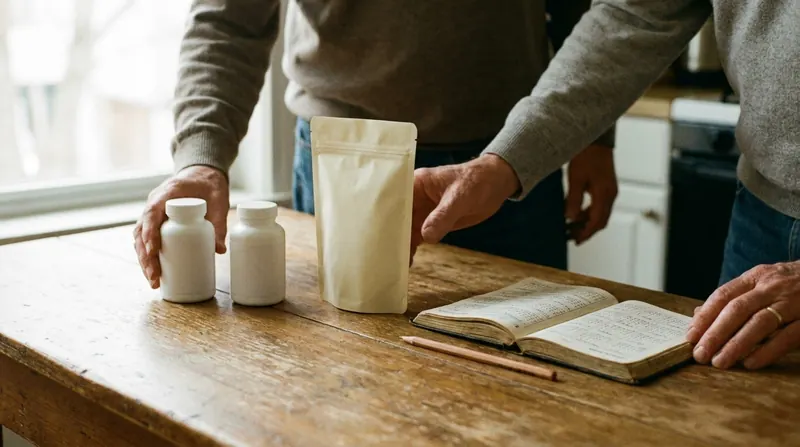
How long does it last?
Each bottle holds 120 capsules, sixty days at two a day, so the two bottles give you 120 days.
The pouch holds 150 grams, which is 150 days at a gram a day.
Take one form each day, and the box is about 270 days: nine months.
Take both forms every day, two grams, and it's 135 days.
That's four and a half months.
What does it cost against the parts?
The seller's page prints the bundle price with a higher "compare at" figure crossed out beside it, $150 the day I read it.
But the seller also sells the parts separately on the same site.
Add two bottles and one pouch at the seller's own prices, and the day I read it the sum was $139.85, not $150.
The bundle is still cheaper than the parts, and the discount is real.
It's just about ten dollars smaller than the crossed-out number makes it look.
And what does a gram cost?
The bundle price divided by 270 grams came to under fifty cents a gram the day I read it.
That's less than the plain bottle works out to on its own.
It's a great deal less than the three-ingredient FOCUS capsule.

Nine months at a gram a day, for a real discount that's smaller than advertised. If you've decided on the mushroom, the box is the cheapest way to most of a year of it.
If you haven't decided, it's nine months of a decision you haven't made.
Who It Suits, and Who It Doesn't

This is worth a look if:
- You've already decided to take lion's mane for months, not weeks, and you want the cheapest honest gram a day the seller sells.
- You like the idea of the same extract in two forms: capsules for the road, powder for the mug.
- You want a label that prints the beta-glucan figure, and a seller that prints its address, its phone number and its email.
- You can hold two ideas at once: a well-made extract, at a third of the trial's daily amount.
- You'll open one bottle, keep the rest sealed, and run twelve weeks with a notebook.
- You already keep the basics: water, walking, a decent plate and people to talk to.
Give it a miss if:
- You wanted the three-ingredient FOCUS capsule. This box doesn't contain it.
- You've never tried lion's mane at all. Buy one bottle first; nine months is a lot of anything.
- You want the trial's daily amount. A gram is a third of it, and at two grams a day the box lasts four and a half months.
- You want something that acts on a condition a clinician has named. This is a dietary supplement, and both labels say so.
- You're allergic to mushrooms. It's a mushroom, in both forms.
- You want to feel something by Friday. Twelve weeks is the fair test, and a week tells you very little.
Five Objections I'd Raise at My Own Kitchen Table
If my brother-in-law showed me this box, I'd have five questions for him.
You probably have the same five, so let's go through them.
"That's a lot of money up front."
It is. You're paying for nine months on day one.
Per gram, it's the cheapest way the seller sells this extract.
But the per-gram price only matters if you use the grams, so if you're unsure, one bottle is the smarter first step.
"What does it taste like?"
The label doesn't describe a taste, and I won't invent one for you.
The seller says the powder goes well in tea, coffee or smoothies.
If you'd rather not taste anything at all, the capsules are the same gram with nothing to taste.
"How long before I know anything?"
Honestly, twelve weeks is the fair test, because that's how long the trial ran.
A week won't tell you much, and neither will a good morning.
That's why the notebook matters more than how you feel on any given day.
"Why not just cook the mushroom?"
You can, and I'd encourage it if you find it at the market, because it's a food first.
The box is for the days you want the same measured amount every morning, skillet or no skillet.
Cooking gives you supper; the label gives you a number.
"I already take a few things every day."
Then the pharmacist is your first stop, before the box and before this page.
Put everything you take in one bag, this box included, and ask one question: does anything here argue with anything else?
Both labels tell you to check if you take anything daily.
Price, taste, time, the skillet and the other bottles. Every one has a plain answer, and none of the answers is "don't worry about it."
If You Do Buy It: One Bottle First, Twelve Weeks, One Notebook
If you're going to spend the money, spend it as a test with a date on it.
And keep most of the box sealed until the test is done.
- Open one bottle and leave the second bottle and the pouch sealed. The seller's return page only takes back unopened items.
- Two capsules with the same breakfast every day for twelve weeks. That's the length of the trial, and sixty days is one bottle.
- Keep your coffee or tea exactly as it was. There's nothing in the capsule to change your morning.
- Write one line a day in a notebook. What you were doing at ten, and how it went.
- Take both labels to the pharmacist before day one if you take anything daily. Both labels tell you to check.
- At the end of the first bottle, read the sixty lines. If they read better, carry on to twelve weeks; if not, stop there, and the calendar below tells you when the sealed items can still go back.
Look at that list the way I do.
Four of the six steps cost nothing at all.
The box is the one you'll pay for, and the notebook and the sealed pouch are the ones that protect you.

A Twelve-Week Calendar, Written Out
Here's how I'd lay the three months out on the kitchen calendar.
It isn't a promise of anything; it's a way to keep yourself honest.
Day one.
Open one bottle, write the date on the lid with a marker, and write the first line in the notebook.
Around day twenty-five.
This is the date that matters for your money, not for your memory.
The return page takes sealed items back with a prepaid label within 30 days of shipping, and with your own postage up to day 60.
If you already know the box isn't for you, send the sealed bottle and pouch back while the label is still prepaid.
Week four.
Read back what you've written, once, and then leave it alone.
Four weeks is too early to judge anything.
The trial ran twelve, so twelve is the fair point to judge.
Around day sixty.
The first bottle runs out, and the return window for the sealed items closes.
Week twelve.
The length of the trial, and the day to read every line from the start.
Read them with your wife, or with the friend from the porch.
Other people are often better judges of us than we are of ourselves.
Twelve weeks, one notebook, and two dates circled for your money. That's a fair test, and it's the only kind I'd put my name to.
From Calgary, Shipped From Nevada, With Two Return Pages
The box is sold by Real Mushrooms on its own website.
That's the only place this page links to.

Who's behind it?
Real Mushrooms Inc., with its office on Fifth Avenue Southwest in Calgary printed on both labels.
There's a toll-free number that takes calls and texts, and an email.
American orders ship from a warehouse in Sparks, Nevada, which is also where returns go.
What about shipping?
Within the United States, shipping costs nothing above the seller's order line, and this box is well above it.
And if it arrives and you don't like it?
Read this part twice, because the seller has two pages, and they don't say the same thing.
The promise page: a hundred days, one opened product per customer, replacement or refund, by email, phone or text, for purchases on the seller's site only.
The return page: unopened products only, a prepaid label within 30 days of shipping, your own postage from 31 to 60 days, and nothing after 60.
For a box of three items, that means one opened item covered by the promise.
The sealed ones are covered by the return page while they stay sealed and the clock hasn't run out.
Ask the seller which page governs a bundle before you pay, and keep the answer.
I'd rather tell you that than call it a refund with no strings.
Everything printed on both labels, the one mushroom in its two forms and the beta-glucan figure, is set out in the ingredient guide linked at the foot of this page.
That guide also carries the cautions, the references in full and the disclosures this page is required to make.
Two bottles and a pouch: one gram a day, for most of a year
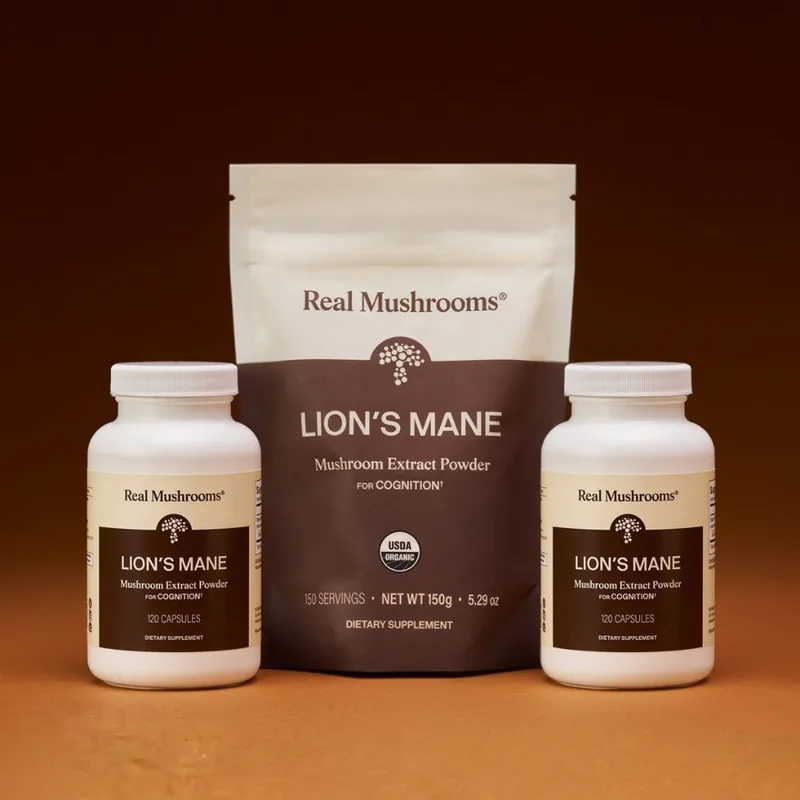
Two bottles of capsules and a pouch of powder from the same organic lion's mane extract, so the gram a day can go down as a capsule or stirred into the morning cup.
SEE THE BOX ON THE SELLER'S PAGESold by Real Mushrooms Inc., Calgary, and shipped within the United States from Sparks, Nevada · 2 × 120 capsules + 150 g of powder, about 270 days at one form a day · shipping at no charge above the seller's order line, which the box exceeds · a 100-day promise on one opened product per customer, and unopened-only returns on the return page: ask how they apply to a bundle before you buy
Short Answers Before Your First Box
Questions readers ask
Is this medicine?
No. It's two dietary supplements in one box, capsules and powder of the same organic lion's mane extract.
Does the bundle include the product called FOCUS?
No. It holds two bottles of plain lion's mane capsules and one pouch of the same extract as powder.
How long does it last?
About 270 days at one form a day, or about 135 days if you take both forms every day.
How does a gram compare with the trial?
The twelve-week trial in adults over 50 used 3.2 grams a day. A gram of this one-to-one extract is about a third of that.
Is there caffeine in it?
No. The powder is the mushroom extract and nothing else, and the capsules add only the capsule, cellulose and silicon dioxide.
Is the discount real?
Yes, and smaller than it looks. The crossed-out figure was $150; the parts add up to about $139.85 at the seller's own prices.
Will it help my memory?
I can't tell you that, and you should be wary of any page that does. The only twelve-week result in people your age came at three times this daily amount.
Can I take it alongside what I already take?
Ask your clinician or pharmacist and bring the ingredient guide. Both labels say to check if you take anything daily.
Does it ship to me?
Within the United States, from Nevada, at no charge above the seller's order line, which this box exceeds.
What if I don't like it?
The promise page covers one opened product for a hundred days, and the return page takes unopened products only. Open one bottle, keep the rest sealed, and ask the seller first.
None for the Box, Eleven Hundred for the Capsules Inside It
One last thing before you decide: what other people say.
The bundle's own page has a review widget, and it's empty.
The capsules inside the bundle have their own page, with more than eleven hundred reviews.
Each of the ones I read carries the seller's buyer mark.
So the reviews below are reviews of the capsules, and I'll say so every time.
I read the ten most recent and kept four, including one at four stars from a woman who says it's too early to tell.
I left out one that spoke of a condition that isn't this page's business, one about a different product, and two that didn't say anything.
These are real customers of the capsules, quoted word for word; the small photos beside them are illustrations, not the reviewers.

I've been taking lions mane for over 5 years & swear I saw a difference in my ability to speak better within 3 months. I'm sharper than before I took them.

I researched many products and Real Mushrooms' Lions Main was the best available on the market. Thanks

It got here to my place less than a week. It's too early to tell any different but I'll keep you posted. I have taken the lion mane Mushroom before not this brand in particular, but other brands and I have confidence in this one.

This mixed with the Cordyceps is my go to in the mornings to help give me the mental and physical boost to help get me through the day.
Read those the way I did.
Susan has taken it for five years and puts her difference at three months in.
That's the one review that matches the shape of the trial: months, not mornings.
Marvin researched brands and picked this one, which is a review of the label, and the label deserves it.
Nina, at four stars, says it's too early to tell, which is the most honest sentence a person can write a week in.
Eric mixes it with the seller's cordyceps and describes his mornings, and routines are real.
Nobody I kept describes their memory coming back. One describes three months, one a label, one a week, one a morning.
Everything Above, in Sixty Seconds
- Names on the porch, paragraphs read twice, doorways: ordinary moments, and you're in large company.
- The basics come first and cost nothing: water, walking, a decent plate, regular rest and friends. [1] [2]
- Lion's mane is a food mushroom; one small twelve-week trial in adults over 50 used 3.2 grams a day and found higher scores on one test and not on another. [3]
- The box is two bottles of capsules and a pouch of powder, one extract, a gram a day in either form, 300 milligrams of beta-glucans printed on both labels, no caffeine.
- A gram is a third of the trial's daily amount, and the box lasts about 270 days at one form a day.
- Despite the name, it doesn't contain the seller's FOCUS capsule, and the parts add up to about ten dollars less than the crossed-out price.
- Open one bottle, keep the rest sealed, write one line a day, and circle the return dates on the calendar.
What Nine Months of a Gram Is Actually Worth
Let's go back to the porch for a second.
The name that went missing, the paragraph you read twice, the kitchen doorway.
Nothing in this box is going to make those moments disappear, and I won't tell you it will.
What it can be is one small, steady, honestly labeled thing you do every morning, for months, and then judge with a notebook.
One honest mushroom in two forms, from a company that prints the figure most sellers leave off.
A gram a day, a third of the trial, for nine months, or two grams for four and a half.
A name that promises a product the box doesn't contain, and a crossed-out price that flatters the discount by about ten dollars.
And a promise that covers one opened item, which is exactly why you open one.
So is it worth it?
For the right man, yes, and I've tried to be plain about who that is.
For everybody else, the glass of water, the walk, the plate and the friend on the porch come first.
They cost nothing, and they were on this page before the box was.
If you're a man who's already decided on lion's mane and wants the cheapest honest year of it the seller sells, that's worth the box.
Not because of the word on the front.
Because you'll know what's in it, how long it lasts, and what the discount really is.
A capsule for the road, a spoon for the cup, and a notebook for the verdict
Two bottles of capsules and a pouch of powder from the same organic lion's mane extract, so the gram a day can go down as a capsule or stirred into the morning cup.
SEE THE BOX ON THE SELLER'S PAGEReal Mushrooms Inc. · 1-800-263-4387 · [email protected] · ships within the United States from Sparks, Nevada · shipping at no charge above the seller's order line · a 100-day promise on one opened product per customer; unopened-only returns on the return page
P.S. If you take one thing from this page, take the two numbers.
One gram a day, a third of the trial, and 270 grams in the box, nine months of it.
P.P.S. If the forgetting has been with you for a year and it's getting in the way of your days, talk to your own clinician before you buy anything.
A gram in the morning is a small habit, and it was never meant to answer the questions a proper check-up answers.